
Betöltés…
A chandelier above the dining table is more than just a source of light. It has a significant impact on the overall look of the dining area, the atmosphere during meals, and the way both the table and the entire interior are perceived. A chandelier that is too small can get lost in the space, while one that is too large may visually overwhelm the room.
So how do you choose the right chandelier size, and how high should it be hung? We have prepared a few simple guidelines and practical examples to make your decision easier.
When choosing a chandelier, it is important to consider primarily the size of the dining table, rather than just the size of the room.
As a general guideline, the width or diameter of the chandelier should be approximately 50–70% of the width of the dining table.
-900x676.png&w=1920&q=85)
For more decorative or crystal chandeliers, you can choose a slightly larger size. The important thing is that the chandelier remains visually proportionate to the table and generally does not extend beyond its edges.
Ideally, there should be at least 15–20 cm of space between the edge of the chandelier and the edge of the tabletop on each side.
For rectangular and longer dining tables, it is worth considering not only the width but also the overall length of the table.
As a general guide, you can use the following dimensions:
Table 120–140 cm
A single chandelier with a diameter of approximately 45–60 cm usually works well.
Table 160–180 cm
A chandelier measuring approximately 55–75 cm can work well, or you may choose a wider or elongated light fixture.
Table 200–220 cm
A more substantial chandelier approximately 70–90 cm wide, an elongated fixture, or a pair of smaller chandeliers can be a suitable choice.
Table 240 cm and longer
For very long tables, two smaller chandeliers often work particularly well. Alternatively, you can use several smaller fixtures or one larger elongated light.
With a long table, it is important that the light is not concentrated only in the centre, but distributed as evenly as possible across the entire tabletop.
The correct hanging height is just as important as the size of the chandelier itself.
In most interiors, we recommend positioning the bottom of the chandelier approximately 70–90 cm above the dining table.
A distance of around 75–80 cm works particularly well in most situations.
At this height, the chandelier sits low enough to visually belong to the dining area and create an inviting atmosphere, while still allowing people seated opposite each other to see one another comfortably.
For larger chandeliers or in households with taller family members, the fixture can be hung slightly higher.
A higher ceiling does not automatically mean that the chandelier should be hung significantly higher above the table.
Above a dining table, the main reference point should be the tabletop, rather than the ceiling itself.
For example, in a room with a ceiling height of 3 or 3.5 metres, you can simply use a longer chain or suspension while still keeping the bottom of the chandelier approximately 70–90 cm above the table.
Larger crystal chandeliers can look particularly impressive in rooms with high ceilings, where they have enough visual space and would not feel overly dominant.
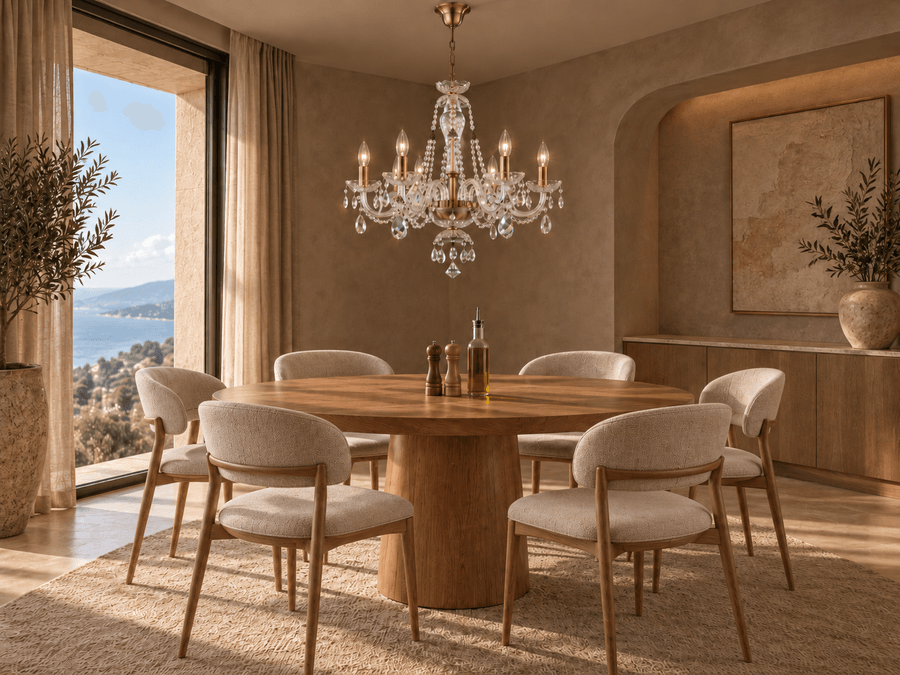
The diameter alone does not always accurately indicate how large a chandelier will appear in a room.
With richly decorated crystal chandeliers, it is also worth considering:
the number of arms,
the amount of crystal decoration,
the height of the chandelier,
the overall complexity of its design,
the ceiling height,
the size of the room.
A lighter chandelier with an open structure may appear more subtle than a richly decorated model with the same diameter.
A statement crystal chandelier can also become the main focal point of the interior, so choosing the largest available size is not always necessary.
Although the dimensions of the dining table are the most important factor, the overall size of the room should also be taken into account when making the final choice.
In a smaller dining room of approximately 10–15 m², a more delicate light fixture will usually look better.
In a large open-plan space where the dining area is connected to the kitchen or living room, a more striking chandelier can be a good choice. It can also help visually define the dining zone from the rest of the interior.
One of the most common mistakes is choosing a chandelier that is too small. A fixture may look substantial in a photograph or showroom, but once installed above a large dining table, it can appear visually lost.
Hanging the chandelier too high can be equally problematic. It may then feel disconnected from the dining area and look more like a general ceiling light.
A chandelier should not be hung too low either. It should not obstruct the view between people sitting opposite each other or interfere with the normal use of the table.
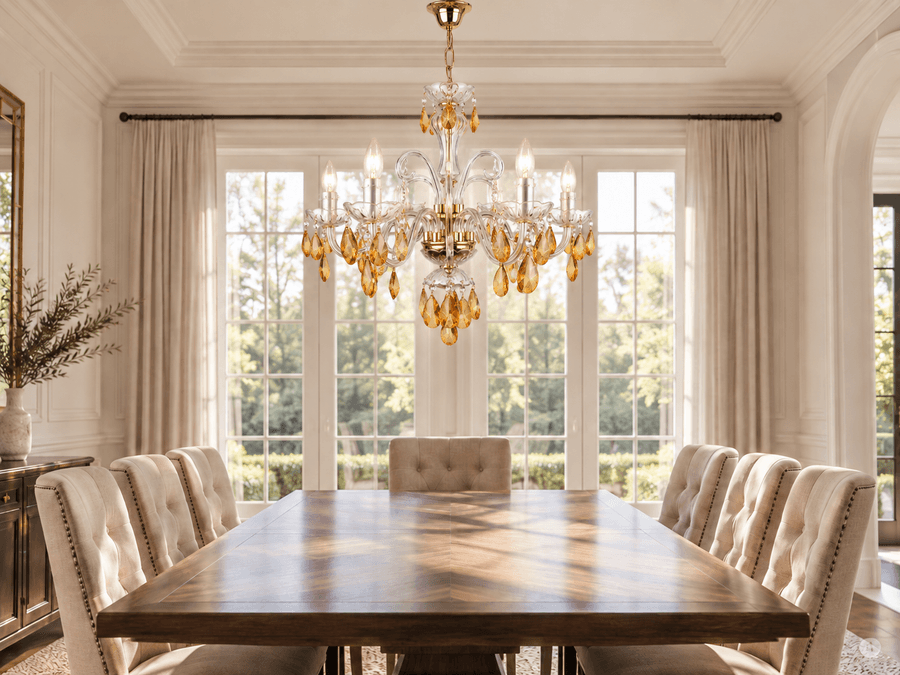
If you want a simple rule of thumb, follow these three basic guidelines:
Chandelier size: approximately 50–70% of the width of the dining table.
Height above the table: approximately 70–90 cm.
Position: centre the chandelier above the dining table, not necessarily in the centre of the entire room.
These guidelines provide a very good starting point for most interiors.
Crystal chandeliers are particularly popular above dining tables because of the way they interact with light. Crystal pendants reflect and refract the light, creating subtle sparkling effects that give the room a more elegant and refined atmosphere.
A crystal chandelier does not have to be limited to traditional interiors. Combining a classic chandelier with a modern dining table, simple chairs and clean surfaces can create an attractive contrast and turn the chandelier into the main design feature of the room.
If you are unsure which size to choose, simply send us the dimensions of your dining table, the ceiling height and a photograph of the room. We will be happy to recommend the right size as well as a suitable chandelier from the Bohemia Lighting collection.
Évente néhányszor, amikor olyasmi hagyja el a műhelyt, amit érdemes megmutatni.